


June 17, 2026
Immigration Evaluations of Texas
Introduction: Why Immigration Evaluations Can Change the Outcome of Your Case
If you or a family member is facing an immigration case involving hardship, trauma, or persecution, the strength of your evidence can make or break the outcome. USCIS officers and immigration court judges look for credible, objective proof-not just personal statements-when making discretionary decisions. That is where an immigration psychological evaluation comes in.
An immigration evaluation translates personal narratives into objective clinical evidence. It is a forensic clinical report, not therapy. A licensed mental health professional conducts a structured assessment, documents mental health symptoms, and connects those findings to the legal standards your case must meet. High-quality professional evaluations can strengthen weak immigration cases by filling gaps that declarations and letters alone cannot cover.
At Immigration Evaluations of Texas, most immigration evaluations are completed and delivered within 5 business days, with rush options available for tight deadlines. Whether you are in Houston, Dallas, the Rio Grande Valley, or anywhere else in the state, our telehealth services and bilingual support make the entire immigration process more accessible.

How Immigration Evaluations Improve Approval Chances
Understanding how immigration evaluations improve approval chances starts with recognizing what USCIS and immigration judges actually need to see. They need clinical findings that match legal standards-terms like “extreme hardship,” “substantial abuse,” or “credible fear” must be backed by more than a heartfelt letter. A professional assessment bridges that gap.
Evaluations uncover hidden trauma like depression or anxiety not previously verbalized. Many immigrants carry years of unspoken suffering that never appears in police reports or medical charts. A thorough evaluation provides compelling evidence for immigration officials’ discretionary decisions by putting those experiences into clinical language that adjudicators understand.
Here are three core ways evaluations help:
- Clarifying mental health impact: Psychological evaluations document trauma and hardship for immigration cases, including diagnoses such as post traumatic stress disorder, major depression, and generalized anxiety.
- Documenting hardship on qualifying relatives: Reports help explain emotional impacts of potential family separation on citizen children, spouses, and parents-connecting those impacts to USCIS hardship factors.
- Boosting credibility: A written report backed by validated testing and clinical interview findings carries more weight than unsupported statements, especially in immigration court.
Research supports this. In VAWA-related cases, applications that included forensic evaluations showed an 81.6% grant rate compared to 42.4% without such documentation. Psychological evaluations assess emotional impacts of family separation in ways that help attorneys build stronger legal arguments.
What Is an Immigration Psychological Evaluation?
An immigration psychological evaluation is a structured mental health assessment conducted for a specific legal context. It results in a written report designed for USCIS or immigration court-not for therapy or ongoing treatment. Its purpose is to document your mental health history, current symptoms, and how your psychological condition connects to the legal standards in your immigration case.
A typical evaluation includes:
- Psychosocial and immigration history
- Trauma history and mental health symptoms
- Functional impact on daily life, work, and relationships
- Diagnostic impressions using DSM-5-TR criteria
- A nexus statement linking clinical findings to legal requirements
Evaluations typically take 1.5 to 3 hours to complete, sometimes across two sessions. At Immigration Evaluations of Texas, reports are 12–20 pages, detailed, and tailored to the specific case type. Every evaluation is conducted by a licensed clinician with training in conducting immigration evaluations and forensic report writing.
One important distinction: psychological evaluations are not confidential in the traditional therapy sense and are shared with attorneys and submitted to USCIS or the court as evidence.
When an Immigration Evaluation Makes the Biggest Difference
Not every immigration case requires a psychological evaluation, but certain case types become significantly stronger with one. Here is where evaluations most often make the difference.
Extreme Hardship Waivers (I-601 / I-601A) and Hardship Waivers
Hardship waivers are documented under I-601 and I-601A, and they require applicants to prove that a qualifying relative-usually a U.S. citizen or lawful permanent resident spouse or parent-would suffer extreme hardship if the waiver is denied. Extreme hardship must be proven for waiver approval by USCIS, and the standard is intentionally high: it must exceed the normal consequences of deportation.
A hardship evaluation documents depression, anxiety, medical caregiving burdens, financial stress, and educational disruption for qualifying relatives. Evaluations document severe psychological or emotional distress in hardship waiver cases by linking clinical findings to the USCIS hardship factors-medical, psychological, educational, financial, and safety-related.
Consider a spouse in Texas whose partner faces inadmissibility. Through a clinical interview, the evaluator documents panic attacks affecting her ability to work, insomnia disrupting her care for their citizen children, and a history of untreated anxiety worsened by the threat of family separation. Evaluations help document trauma and caregiving challenges faced by immigrants in exactly this way. Psychological evaluations can increase approval rates for hardship waivers, though no evaluation guarantees approval-the report must clearly show severity and functional impairment.

Cancellation of Removal and Immigration Court Cases
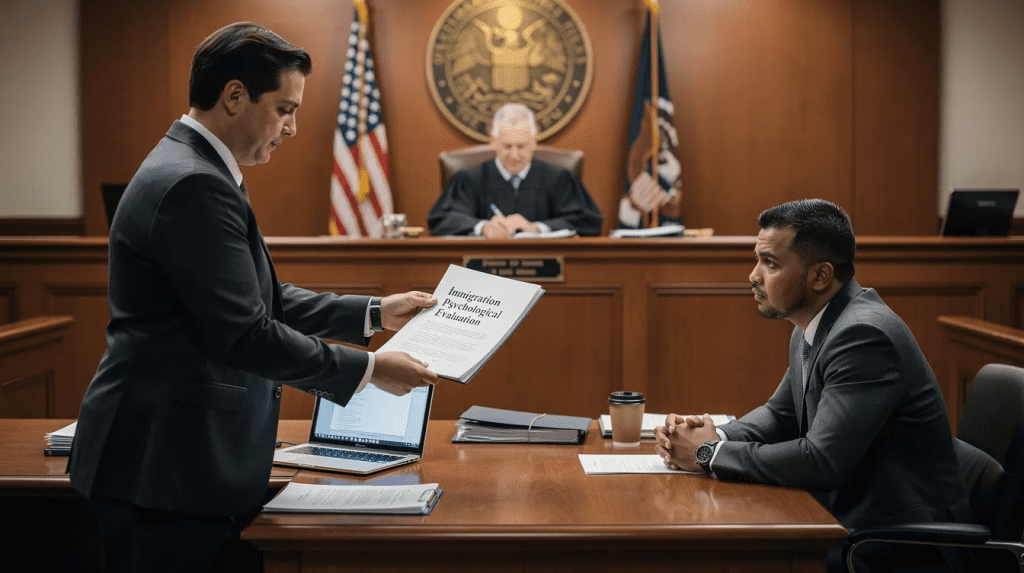
Cancellation of removal requires proving “exceptional and extremely unusual hardship” to a qualifying family member in immigration proceedings. Psychological evaluations assess emotional impact of removal by documenting how deportation would affect U.S.-based relatives-particularly citizen children whose lives would be upended.
Evaluations document extraordinary hardship for U.S. family members through findings such as regression in children, declining school performance, panic attacks in spouses, and loss of critical caregiving. Reports help articulate mental health challenges in removal cases with clinical specificity that letters from friends or community members cannot match. Judges in immigration court often give more weight to well-supported clinical reports, and psychological evaluations can influence approval or denial outcomes. Immigration Evaluations of Texas has experience preparing reports timed to hearing dates so attorneys are never left scrambling.
VAWA Self-Petitions
The Violence Against Women Act provides immigration relief for survivors of domestic violence perpetrated by U.S. citizen or LPR spouses, parents, or children. VAWA evaluations are crucial for survivors of domestic abuse seeking residency because the abuse may be primarily emotional or psychological, making it harder to prove without clinical documentation.
VAWA evaluations document trauma effects like PTSD or depression, and psychological evaluations help outline safety fears for VAWA applicants. Dr. Ramos conducts VAWA evaluations to assess mental state for immigration, using trauma-informed techniques that help survivors tell their full story in a safe environment. Survivors often minimize what happened to them-a skilled evaluator gently helps uncover the scope of abuse. Reports from VAWA evaluations support legal arguments in immigration cases by connecting coercive control and its mental health consequences to the legal standards under the women act. Bilingual and culturally responsive assessment is essential for many VAWA cases in Texas.
U-Visa and T-Visa Cases
A u visa is for victims of serious crimes who have cooperated with law enforcement. Psychological evaluations assess the impact of crime on mental health, capturing fear, hypervigilance, and difficulty trusting that may not appear in police reports. Evaluations help document trauma for u visa applications, and reports from evaluations are submitted with u visa petitions as supporting evidence. U-Visa applications require evidence of cooperation with law enforcement, and the evaluation provides the clinical context explaining why victims may have delayed reporting or given inconsistent accounts.
A t visa is for victims of human trafficking. Psychological evaluations help document trauma for t visa applicants by capturing the lasting psychological damage of exploitation. Evaluations assess the lasting impacts of coercion and exploitation, and t visa evaluations can clarify psychological distress from trafficking-including shame, fear of retaliation, and dissociation. Reports from evaluations support legal arguments for t visa cases. Immigration Evaluations of Texas uses trauma-informed, cross-cultural approaches appropriate for victims of violence and trafficking.
Asylum and Withholding of Removal
Asylum seekers must demonstrate credible fear of persecution based on protected grounds. Forensic evaluations can document evidence of torture or trauma in asylum cases, providing clinical proof that supports testimony. A clinical evaluation can document an applicant’s mental health correlating with past persecution-connecting nightmares, flashbacks, and avoidance behaviors to the events described.
Memory gaps, flat affect, and inconsistent timelines are common among asylum seekers with severe trauma, and evaluations explain these as symptoms rather than signs of dishonesty. Studies involving Physicians for Human Rights evaluations found over 90% success in asylum cases with such evaluations, compared to roughly 30% nationally without them. Importantly, culturally competent evaluations help articulate complex legal cases by accounting for how distress manifests differently across cultures.
Other Case Types: SIJS, Removal of Conditions, N-648, and More
Evaluations support claims for Special Immigrant Juvenile Status by documenting abuse, neglect, or abandonment of minors and their psychological consequences. For removal of conditions, evaluations may address how domestic abuse affected a marriage-based case. N-648 naturalization waivers require documentation of cognitive or severe psychiatric conditions preventing test-taking.
Immigration Evaluations of Texas focuses on the psychological aspects of these cases and can coordinate with physicians when medical documentation is also needed.
The Immigration Evaluation Process: What Clients Can Expect
The process is designed to be transparent, safe, and efficient. Here is what happens from first contact through report delivery.
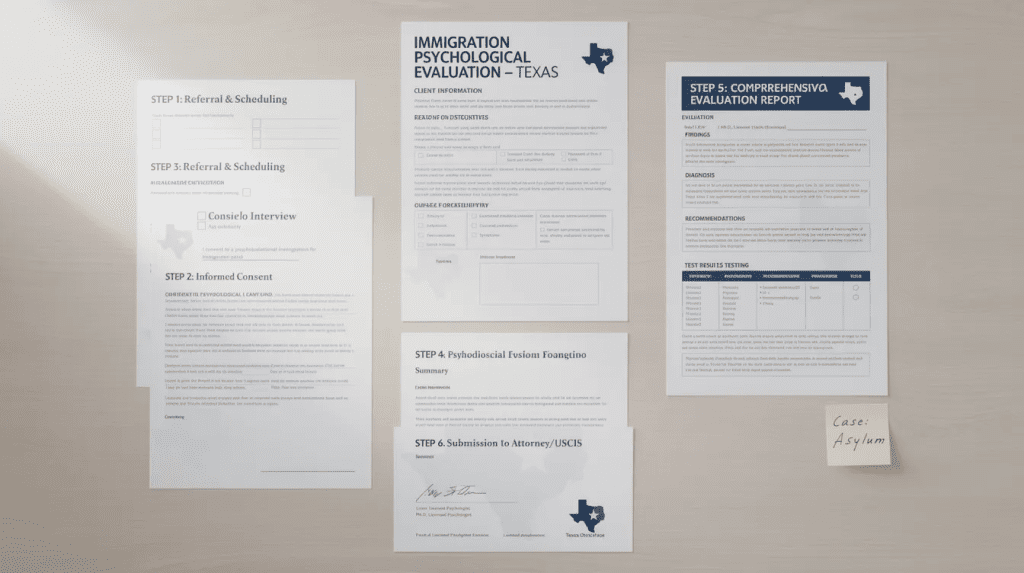
Step 1: Appointment scheduling and Case Screening
Most clients come through self-referrals. During an initial 15–20 minute consultation, the evaluator discusses the case type, deadlines, language needs, and fees. The clinician also determines whether a psychological evaluation is likely to add meaningful value to the immigration case.
Step 2: Intake Forms and Document Gathering
Clients complete online intake forms including consent for forensic evaluation, confidentiality limits, and a background questionnaire. Required documents commonly include USCIS forms (I-601, I-601A, I-360, I-918, I-914, I-589), police reports, medical records, school reports, and prior mental health notes. Thorough documentation improves accuracy and speeds up report writing.
Step 3: Clinical Interview (Telehealth or In-Person Video)
The clinical interview usually lasts 2–3 hours, sometimes split into two sessions to reduce emotional strain. It covers immigration history, family background, trauma history, current mental health symptoms, daily functioning, and support systems. Immigration Evaluations of Texas offers secure telehealth throughout Texas and bilingual English/Spanish services. The licensed mental health professional moves at the client’s pace, with breaks as needed.

Step 4: Psychological Testing and Collateral Information
The evaluator may administer brief, validated questionnaires for PTSD, depression, or anxiety to add objective data to the mental health assessment. Collateral interviews-with the client’s written permission-may include conversations with spouses, relatives, teachers, or pastors. Not every case requires formal testing; the evaluator chooses what is necessary and appropriate.
Step 5: Report Writing, Review, and Delivery
Standard report turnaround time is 2–3 weeks industry-wide. At Immigration Evaluations of Texas, reports are typically delivered within 5 business days after the final interview, with 24–48-hour rush options. Evaluations typically take 2–3 weeks to complete after interviews at most immigration evaluations providers, and initial appointment scheduling typically takes 1–2 weeks, meaning the total evaluation process can take about 4–6 weeks if you wait. Rush service can deliver reports in 1 week or less.
The written report includes background, clinical interview findings, test results, diagnoses, clinical findings tied to legal standards, and recommendations.
Translating Clinical Findings into Legal Hardship
Evaluators do not give legal opinions-they document mental health impacts in legally relevant ways. For example, connecting panic attacks to inability to maintain employment, or depression limiting parenting capacity. Well-organized clinical findings make it easier for USCIS or the court.
Improving Credibility and Consistency
Immigration evaluations help reconcile apparent inconsistencies in testimony by explaining trauma-related memory issues or cultural communication differences. Mental health practitioners who use standardized measures and collateral data produce reports that stand out as credible evidence. Judges and USCIS officers see many unsupported claims-a professional assessment backed by testing carries more weight.
Addressing Common Concerns and Myths
A reputable licensed mental health professional will tell you if an evaluation is unlikely to help your case. Evaluations are an investment-typically paid out-of-pocket-but can prevent costly denials or delays. The process is respectful and nonjudgmental, even for those who fear discussing trauma or mental health. Many immigrants worry about what happens during the process, but the practice is designed to be safe and supportive.
Cost, Timeline, and Practical Considerations
Standard evaluations cost between $700.00 and $ 1000.00 depending on complexity. Complex cases can exceed $3,000 in evaluation costs. Expedited evaluations incur an additional fee of $250–$500, and rush service incurs an additional fee of $250 to $500. Interpreter services cost between $50 and $150 per hour. Insurance typically does not cover immigration evaluations because they are forensic, not therapeutic. Some providers, including some mental health practitioners in Texas, offer payment plans to help manage costs.
Costs vary based on case type, number of sessions, and urgency. Immigration Evaluations of Texas can share exact fees during a consultation. We also offer payment plans for qualifying clients. Schedule your evaluation ideally 6–10 weeks before your USCIS or immigration court deadline to allow adequate preparation time.
How to Prepare for Your Immigration Evaluation
A little preparation goes a long way toward a more accurate and useful evaluation.
Documentation and Personal Timeline
Prepare a written timeline of major life, trauma, and immigration events with approximate dates. Bring or upload medical records, prior therapy notes, school reports, and any previous psychological assessments. List all medications, diagnoses, and hospitalizations along with dates and providers.
Emotional and Practical Readiness
Expect some emotional discomfort when discussing painful events, and plan self-care afterward. For telehealth sessions, arrange privacy, stable internet, and childcare to reduce interruptions. It is okay not to remember everything perfectly-honesty about uncertainty is better than guessing. Your therapist or evaluator will guide the conversation at your pace.
Immigration Psychological Evaluation vs. Therapy
An immigration psychological evaluation serves a fundamentally different purpose than therapy. Therapy is ongoing, confidential, and focused on healing. A forensic evaluation is time-limited (usually one to two sessions), produces a written report for a legal context, and its contents are shared with attorneys and adjudicators. Ethical guidelines usually prevent the same licensed clinician from conducting evaluations and providing long-term therapy for the same case.
That said, the evaluation process sometimes surfaces difficult emotions. Immigration Evaluations of Texas encourages clients to pursue therapy as well and can provide referrals to trusted community therapists. Licensed social workers, psychologists, and other mental health practitioners in your area can provide the ongoing support that complements the evaluation.
Share
Recent Posts

How to Choose the Right Immigration Evaluation Provider in Texas
August 3, 2026
If you or a loved one is facing an immigration case in Texas, knowing how to choose the right immigration evaluation provider in...

How T Visa Psychological Evaluations Strengthen Immigration Cases
July 31, 2026
Survivors of human trafficking face some of the most harrowing experiences imaginable, from involuntary servitude and debt bondage to sexual assault and forced...

How VAWA Psychological Evaluations Support Your Immigration Case
July 29, 2026
If you or someone you know has experienced domestic violence at the hands of a qualifying family member, VAWA psychological evaluations can be...