


August 31, 2026
Immigration Evaluations of Texas
VAWA, the Violence Against Women Act, allows certain survivors of domestic violence and extreme cruelty committed by a U.S. citizen or lawful permanent resident to file a self petition for immigration relief. Despite its name, VAWA protections apply to all survivors regardless of gender, including spouses, children, and parents of abusive citizens or lawful permanent residents.
VAWA is not a visa. It is a pathway to lawful permanent resident status through Form I-360. Self-petitioners must file Form I-360 to apply for VAWA, and the law requires self-petitioners to show they experienced battery or extreme cruelty during a qualifying relationship.
Here is the critical point many people miss: abuse often leaves far deeper psychological scars than visible injuries. A spouse controlled financially and emotionally for years may have no broken bones, no hospital visits, and no police reports. But the fear, depression, and nightmares that follow them daily are just as real as any bruise.
Consider this scenario: a woman married to a U.S. citizen endures years of threats, isolation, and verbal humiliation. She never calls the police because her husband warns her she will be deported. Her mental health evidence, documented through a forensic evaluation, becomes the foundation of her entire case.
What Is “Mental Health Evidence” in VAWA Cases?
Mental health evidence refers to any professional, clinical, or treatment documentation that shows the emotional and psychological impact of domestic violence or extreme cruelty on a survivor.
This can include several types of records:
- Psychological evaluations (forensic assessments written for legal purposes)
- Therapy and counseling notes from licensed clinicians
- Diagnostic summaries with DSM-5 diagnoses
- Psychiatric medication records
- Hospital or emergency room mental health notes
- Letters from licensed psychologists, social workers, or counselors
There is an important distinction to understand. A survivor’s own written statement, often called a personal declaration, is subjective evidence. It tells the story in the survivor’s own words, and USCIS requires it. But mental health evidence from a licensed professional serves as objective, corroborating evidence that validates the survivor’s experience and translates it into clinical language.
Think of it this way: your declaration tells USCIS what happened. A psychological evaluation tells them what it did to you, clinically and measurably.
If you do not have a legal background, that is perfectly fine. The goal of this section, and this entire article, is to explain these concepts in straightforward language so that any survivor can follow along and feel informed.

Why Mental Health Evidence Matters in VAWA Applications
Mental health evidence helps USCIS understand the full severity of abuse, especially when police or medical records are missing. It gives adjudicators a window into what the survivor actually endured, even if no one else witnessed it.
Mental health evidence enhances the credibility of VAWA claims by providing independent professional corroboration of the survivor’s account. When a licensed clinician documents symptoms consistent with the described abuse, it signals to USCIS that the story is not only plausible but clinically supported.
Psychological evidence supports key eligibility elements in several ways:
- It demonstrates battery or extreme cruelty by showing the severity and duration of harm
- It can reference details about residence with the abuser, daily routines, and household dynamics
- It documents the long-term impact on daily functioning, including work, parenting, and social life
USCIS uses a “preponderance of the evidence” standard for VAWA cases. This means the evidence only needs to show that the claim is “more likely than not” true. Mental health documentation can tip a close case in the survivor’s favor when other evidence is limited.
Here is a concrete example. Imagine a survivor who never called the police, never went to the ER, and has no restraining order. But a forensic psychological evaluation documents severe PTSD symptoms, including nightmares about specific incidents, hypervigilance, and functional impairment at work. That evaluation becomes the anchor of the case, filling the gap left by absent traditional records. Mental health evaluations document emotional abuse that leaves no physical marks, making them especially valuable in these situations.
Common Mental Health Conditions Seen in VAWA Cases
Domestic violence frequently results in diagnosable mental health conditions. Psychological assessments document symptoms like PTSD and anxiety caused by abuse, giving USCIS a clear clinical picture of the harm.
The most common conditions seen in VAWA cases include:
| Condition | Key Symptoms | How It Appears in Daily Life |
| PTSD (Post-Traumatic Stress Disorder) | Flashbacks, nightmares, hypervigilance | Difficulty sleeping, avoiding places or people, constant alertness |
| Major Depressive Disorder | Persistent sadness, loss of interest, fatigue | Withdrawal from activities, difficulty caring for children, hopelessness |
| Generalized Anxiety Disorder | Chronic worry, restlessness, muscle tension | Trouble concentrating at work, irritability, physical complaints |
| Panic Disorder | Sudden panic attacks, chest pain, fear of dying | Avoidance of public places, inability to drive or shop alone |
| Adjustment Disorder | Emotional distress following a major stressor | Difficulty adapting after leaving the abuser, trouble with daily tasks |
Research consistently shows that chronic abuse can lead to PTSD and depression. A recent community study of IPV survivors found that 52.3% had probable PTSD, 47.6% had depression, and 53.3% had anxiety, compared with rates below 10% in those without exposure to intimate partner violence.
A formal diagnosis is not required to file a VAWA self petition. But when a diagnosis is present and well-documented, it can significantly strengthen the case by giving USCIS measurable, clinical proof of harm.
Battery, Extreme Cruelty, and Psychological Harm
USCIS defines “battery or extreme cruelty” broadly. It includes not only physical harm but also psychological, sexual, and emotional abuse. Sexual violence is included as a form of abuse under VAWA. Physical harm is a recognized form of abuse in VAWA cases. And critically, VAWA recognizes emotional abuse as a form of abuse, even when there are no visible injuries at all.
Examples of extreme cruelty that primarily harm mental health include:
- Threats of deportation or reporting to ICE
- Constant humiliation or degradation, including in front of children or family
- Forced isolation from friends, community, or support networks
- Controlling all finances and denying access to money
- Repeated verbal attacks and criticism designed to destroy self-worth
These behaviors may not leave scars a doctor can photograph. But they leave deep psychological wounds that a trained evaluator can identify and document.
Psychological evaluations translate these lived experiences into clinical language that USCIS officers understand and recognize as serious harm. When an evaluator writes that a survivor meets criteria for PTSD based on specific incidents of coercive control and verbal abuse, it directly maps onto the legal definition of extreme cruelty used in immigration law.
Forms of Abuse That Especially Impact Mental Health
Some patterns of abuse leave especially deep emotional scars, even when there is not a single visible injury. Understanding these patterns helps survivors, attorneys, and evaluators build more complete cases.
Emotional and verbal abuse includes insults, threats, gaslighting, public humiliation, and constant criticism. Research shows that psychological abuse alone can produce symptoms equal in severity to physical abuse. A meta-analysis on psychological intimate partner violence found that coercive control is a recognized form of abuse under VAWA and had a moderate-to-strong correlation with PTSD (r ≈ .32).
Immigration-related abuse is particularly devastating for immigrant survivors. Immigration status can be used as a tool of control in abuse. Abusers may threaten to call ICE, hide passports and work permits, or lie about immigration processes to keep the survivor trapped. These threats create chronic fear and helplessness that permeate every aspect of daily life.
Financial control and isolation include preventing the survivor from working or attending school, cutting off access to bank accounts, and controlling all communication with family and friends. Financial control is considered a form of abuse in VAWA cases, and isolation is a form of abuse recognized by VAWA.
Mental health evidence can document the cumulative effect of these behaviors over months or years, showing USCIS that what may look like “just arguments” from the outside was actually a systematic pattern of control and degradation.

How Trauma Affects the Brain and Behavior
Chronic abuse keeps the brain in “survival mode.” When someone lives under constant threat, the stress response system stays activated, changing how the brain processes sleep, memory, and emotions.
Research-backed effects of prolonged trauma include:
- Hypervigilance (always scanning for danger, even in safe settings)
- Difficulty recalling exact dates, sequences, or details of abusive events
- Emotional numbing or dissociation (feeling “checked out” or detached)
- Problems trusting others, including therapists, attorneys, and even supportive family members
These changes are not signs of dishonesty. They are well-documented neurobiological responses to chronic stress. The National Center for PTSD and other leading trauma organizations have published extensively on how trauma disrupts memory encoding and retrieval.
This matters enormously in VAWA cases. USCIS adjudicators need to understand why survivors may not leave quickly, may minimize abuse during interviews, or may struggle to provide a perfectly detailed timeline. Psychological evaluations can help explain behavior such as delayed reporting by placing it in the context of trauma science rather than letting it be misinterpreted as inconsistency or fabrication.
Why Survivors May Lack Traditional Evidence
Many VAWA self petitioners do not have police reports, restraining orders, or emergency room records. This does not mean the abuse did not happen. It usually means the survivor faced barriers that made reporting impossible or terrifying.
Common reasons include:
- Fear of deportation if they contact law enforcement
- Language barriers that prevent communicating with police or doctors
- Financial dependence on the abuser, with no money to seek help independently
- Cultural or religious pressures to keep family problems private
- Threats by the abuser to take away children
- Deep distrust of government authorities based on past experiences
Trauma bonding, the psychological attachment that forms between an abused person and their abuser, can also delay reporting. Survivors often hold onto hope that the abuser will change, especially when the abuser alternates between cruelty and affection.
Mental health evidence can bridge evidentiary gaps in VAWA cases by documenting the survivor’s story and its emotional consequences in a credible, professional format. Comprehensive evaluations are critical when traditional evidence is unavailable, because they provide the detailed, clinical documentation that replaces missing police and medical records.
The Role of Psychological Evaluations in VAWA Cases
A VAWA psychological evaluation is a structured assessment by a licensed mental health professional that documents the psychological impact of domestic violence or extreme cruelty. It is not therapy. It is a forensic tool designed to serve a legal purpose.
A typical evaluation includes:
- A detailed clinical interview covering the relationship, abuse history, and current symptoms
- Administration of standardized trauma and symptom measures (such as PTSD checklists, depression scales, and anxiety inventories)
- Review of relevant records, including the survivor’s personal declaration and any available documentation
- A comprehensive written report, usually 12 to 20 pages, with diagnoses, clinical opinions, and clear connections between abuse and symptoms
Clinical reports clarify the links between abuse and trauma symptoms, making the survivor’s experience legally meaningful. Psychological evaluations document trauma symptoms and emotional harm in a way that personal statements alone cannot achieve.
Mental health evaluations provide corroboration of an applicant’s personal narrative, and psychological evaluations provide expert corroboration of abuse narratives. These evaluations are used not only in VAWA cases but also in U-Visa, T-Visa, asylum, and hardship waiver cases. Professional psychological reports can support various immigration applications across multiple case types.
Psychological Evaluations vs. Regular Therapy Letters
There is a significant difference between a short “to whom it may concern” therapy letter and a comprehensive forensic psychological evaluation prepared for a VAWA case.
| Feature | Therapy Letter | Forensic Psychological Evaluation |
| Length | Typically 1–2 pages | Usually 12–20 pages |
| Focus | Treatment and healing | Legal documentation and causation |
| Structure | Often informal, brief | Systematic with multiple sections |
| Legal awareness | May not address USCIS criteria | Written with immigration law standards in mind |
| Diagnosis detail | Sometimes vague | DSM-5 diagnoses with supporting evidence |
| Symptom-abuse link | Often general | Specific incidents tied to specific symptoms |
Treatment providers focus on helping survivors heal. Forensic evaluators focus on careful documentation, objectivity, and clear links between abuse and mental health harm. Psychological evaluations help meet USCIS evidentiary standards precisely because they are designed for adjudicators, not clinicians.
If you are a survivor or an immigration attorney selecting an evaluator, ask specifically about their experience with immigration cases and VAWA psychological evaluations. The quality of the report matters enormously, and not every therapist knows how to write one that meets USCIS expectations. To avoid common pitfalls, review this guide on top mistakes to avoid during an immigration psychological evaluation.
How Mental Health Evidence Strengthens Each VAWA Requirement
Mental health evidence is not just “extra.” It can help prove several statutory elements required for a VAWA self petition.
Abuse element (battery or extreme cruelty): Evaluations support this requirement by showing the severity, duration, and pattern of extreme cruelty. Documentation of behavioral patterns can be pivotal for VAWA claims, especially when the abuse was primarily psychological or emotional.
Qualifying relationship: Applicants must demonstrate a qualifying relationship to an abuser. Mental health reports often contain rich detail about the relationship dynamic, including how the abuser used the marriage or family bond as a weapon of control.
Residence with the abuser: Self-petitioners must provide evidence of cohabitation with the abuser. Psychological evaluations frequently reference daily routines, household details, children’s schedules, and living arrangements that corroborate shared residence.
Good moral character: Self-petitioners must demonstrate good moral character for eligibility. Sometimes trauma leads to behaviors, such as substance use or minor legal issues, that could raise questions. Evaluations can provide context, showing that these behaviors were direct consequences of trauma rather than reflections of character.
Extreme hardship: When relevant, psychological evidence can show that the cumulative harm impairs functioning so severely that returning the survivor to their home country or denying relief would cause extreme hardship.
What USCIS Looks For in Mental Health Documentation
USCIS gives more weight to detailed, specific, and internally consistent reports from licensed professionals. USCIS accepts any credible evidence relevant to VAWA self-petitions, but not all evidence carries the same weight. USCIS evaluates VAWA cases based on the totality of the evidence, meaning every piece matters.
Qualities of strong mental health documentation include:
- Clear professional credentials and licensing information
- Transparent explanation of evaluation methods (interview, standardized measures, record review)
- Specific examples of abusive incidents connected to specific symptoms
- DSM-5 diagnoses when clinically appropriate, with supporting rationale
- A clinical opinion on the credibility of the survivor’s self-report
- Discussion of functional impairment (how symptoms affect work, parenting, daily activities)
Expert clinical opinion is important for establishing clinical links in VAWA cases. Adjudicators rely on evaluators to explain the “so what” behind a diagnosis.
Vague, one-paragraph letters with no dates, no diagnosis, and no clear connection to the abuse provide limited help. Evidence of abuse must be credible and detailed for VAWA applications to succeed.
One more thing: mental health evidence should never exaggerate or fabricate symptoms. Accuracy and honesty are paramount. USCIS adjudicators are trained to spot inconsistencies, and an inflated report can damage credibility far more than a modest but truthful one.
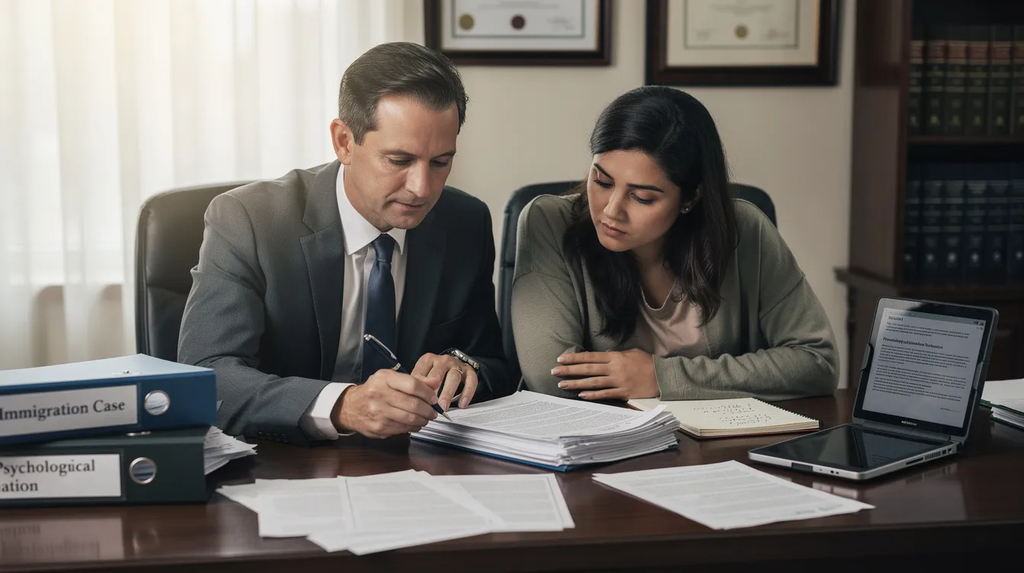
Who Can Provide Mental Health Evidence for VAWA?
USCIS commonly accepts documentation from the following types of licensed professionals:
- Licensed psychologists (Ph.D. or Psy.D.)
- Psychiatrists (M.D. or D.O.)
- Licensed clinical social workers (LCSW)
- Licensed professional counselors (LPC)
- Marriage and family therapists (LMFT)
A psychiatrist or psychologist is not strictly required, but the evaluator must be licensed and trained to assess trauma and domestic violence in a forensic context.
Group counseling records, domestic violence shelter counselors, and case managers can also provide helpful supporting letters. However, these typically carry different evidentiary weight than a formal forensic evaluation from a licensed clinician.
Survivors should coordinate with their immigration attorney to choose the right type of evaluator for their self petition. The attorney can advise on what kind of documentation will best fill the gaps in the existing evidence package.
Choosing a Forensic Evaluator for Your VAWA Psychological Evaluation
Not all mental health professionals have the training or experience needed to write evaluations that hold up under USCIS review. Here is what to look for:
- Specific experience with VAWA cases and immigration law standards
- Training in trauma-informed, culturally responsive assessment
- Familiarity with the legal definitions of battery and extreme cruelty
- Willingness to collaborate with your immigration attorney if clarification or updates are needed
Practical questions to ask a potential evaluator:
- What languages do you offer? Do you use professional interpreters?
- Is telehealth available?
- What is your typical report length and turnaround time?
- Have you worked with USCIS-submitted reports before?
Immigration Evaluations of Texas provides forensic-quality VAWA psychological evaluations with a standard 5-day turnaround and 24 to 48-hour rush options when deadlines are tight. Evaluations are available via secure telehealth, with bilingual English-Spanish services.
Make sure your evaluator is willing to work with your immigration attorney. Cases sometimes require revisions, additional detail, or responses to USCIS requests, and a collaborative evaluator makes that process smoother.
Preparing for a VAWA Psychological Evaluation
A little preparation can lower anxiety and help you share important details more clearly during the evaluation.
Before your appointment:
- Write a brief timeline of the relationship and abuse, including major incidents, approximate dates, and locations. It does not need to be perfect.
- Gather any relevant documents you have: text messages, emails, photos, court records, medical notes, and prior therapy records. Even partial records help.
- Think about how the abuse has affected your daily life: sleep, work, relationships with your children, ability to concentrate, appetite.
During the evaluation:
- Be honest about sensitive topics, including sexual abuse, self-harm, and substance use. The evaluator is not there to judge you; they are there to document the truth.
- Know that evaluations are confidential and conducted in a trauma-informed manner. You can take breaks when needed.
- It is okay to say “I don’t remember the exact date.” Approximate timeframes are completely acceptable and evaluators understand why trauma affects memory.
How Mental Health Evidence Supports Collaboration with Immigration Attorneys
Strong VAWA cases usually involve collaboration between three people: the survivor, the immigration attorney, and the mental health evaluator.
Attorneys use psychological evaluations in several critical ways:
- Crafting legal arguments that connect clinical findings to statutory requirements
- Preparing detailed affidavits that align with the evaluation’s findings
- Responding to Requests for Evidence (RFEs) from USCIS about the severity or nature of abuse
- Planning for interviews by anticipating questions about the survivor’s mental state and functioning
The evaluator provides the clinical significance; the attorney translates it into a legal narrative. For example, an attorney might receive an RFE asking for more detail about the extreme cruelty the survivor experienced. A well-documented VAWA psychological evaluation describing PTSD symptoms directly linked to specific incidents of coercive control can resolve that RFE and move the case forward.
This kind of collaboration is why choosing an evaluator experienced in immigration cases matters so much. Evaluators who understand what attorneys need can write reports that serve the legal process without compromising clinical integrity.
Telehealth Mental Health Evaluations for VAWA Self-Petitioners
Telehealth evaluations have become a safe, accessible option for survivors who may be isolated, lack transportation, or fear being seen visiting a local mental health provider.
At Immigration Evaluations of Texas, most VAWA psychological evaluations can be completed via secure video, with bilingual or interpreter support when needed. This means a survivor in any part of the U.S. can access a specialist experienced in immigration cases without leaving their home.
Benefits of telehealth evaluations include:
- Privacy and safety from within your own home
- Flexible scheduling, including evenings and weekends
- Access to evaluators with specific immigration expertise regardless of your geographic location
- Reduced barriers related to transportation, childcare, or work schedules
Telehealth evaluations are accepted by USCIS as long as they meet professional standards and licensing requirements. The format does not diminish the quality or credibility of the report.

Statistics and Research on Mental Health Evidence in Immigration Cases
The data strongly supports the value of mental health documentation in VAWA and related immigration cases.
Forensic evaluations improve VAWA grant rates to 81.6%. That means 81.6% of VAWA cases with psychological evaluations are granted, a substantial increase compared to cases submitted without professional mental health documentation. This statistic underscores why comprehensive evaluations are not optional extras but strategic necessities.
Research on immigrant survivors paints a stark picture. Immigrant women report lifetime IPV rates as high as 93%, reflecting the compounded vulnerabilities of immigration status, language barriers, and social isolation. These numbers reveal just how widespread and severe the problem is within the population most likely to file VAWA self petitions.
From a clinical perspective, studies consistently show that psychological abuse produces mental health outcomes as severe as physical violence. A study on migrant women survivors found that 53.5% had clinically significant depression and 34.6% had PTSD. Psychological evaluations document trauma symptoms and emotional harm that might otherwise go entirely unrecognized.
VAWA self-petition filings have also increased dramatically. From FY2020 to FY2024, Form I-360 VAWA filings increased by approximately 360%. This surge means adjudicators are reviewing more cases than ever, making thorough, well-supported evidence even more important for standing out.
Addressing Concerns and Myths About Mental Health Evidence
Survivors often carry fears about mental health documentation that are based on misunderstanding rather than reality. Let us address the most common ones.
“If I see a therapist, USCIS will think I am weak.” Seeking mental health care does not hurt a VAWA case. It strengthens it. USCIS views engagement in treatment as evidence that the survivor takes their well-being seriously and that the abuse had real, documented consequences.
“I waited too long to get help.” Mental health evidence can be created now, even if the abuse happened years ago, and still be highly relevant to the self petition. Evaluators routinely assess trauma that occurred in the past, and delayed help-seeking is a well-understood response to chronic abuse.
“I don’t have a diagnosis, so I will be denied.” A formal diagnosis helps, but USCIS does not require one. What matters is credible, consistent, and detailed evidence of the psychological impact of abuse. Many successful cases include evaluations that describe significant symptoms below the threshold of a full diagnosis.
“My memories are too fuzzy to be believed.” USCIS does not require perfection. Adjudicators trained in trauma-informed review understand that gaps in memory are a common and scientifically documented response to chronic abuse, not a sign of dishonesty.
How Immigration Evaluations of Texas Supports VAWA Survivors
Immigration Evaluations of Texas specializes in forensic psychological evaluations for immigration cases, including VAWA, U-Visa, T-Visa, asylum, hardship waivers, SIJS, and cancellation of removal.
Key features of our services include:
- 12 to 20-page forensic-quality reports tailored to USCIS standards
- Telehealth availability for clients anywhere in the U.S.
- Culturally sensitive, trauma-informed care
- Spanish-English bilingual evaluations
- Standard 5-day turnaround with 24 and 48-hour rush options
- Close collaboration with immigration attorneys to ensure reports address the specific legal questions in each case
We understand how difficult it is to talk about domestic violence. Every evaluation is conducted with compassion, confidentiality, and respect. If you are ready to take the next step, we invite you to schedule a confidential consultation.
Conclusion: Taking the Next Step Toward Safety and Status
Mental health evidence helps USCIS see the full picture of what you survived, not just visible injuries but the deep psychological harm that defines extreme cruelty. It strengthens self petitions, fills evidentiary gaps, and provides the clinical detail that adjudicators need to grant relief.
Seeking a VAWA psychological evaluation is an act of courage and self-protection, not a sign of weakness. You are not just filing paperwork; you are building a path toward safety and lawful permanent resident status.
If you are a survivor or an immigration attorney preparing a VAWA case, we encourage you to contact Immigration Evaluations of Texas to schedule a VAWA psychological evaluation. Evaluations are available by phone or online booking, with telehealth options, bilingual services, and turnaround as fast as 24 hours.
You deserve safety, status, and a future free from abuse. Everything you share with us is treated with confidentiality and respect, always.
Share
Recent Posts

Immigration Psychological Evaluation vs Therapy: What Is the Difference?
September 18, 2026
An immigration psychological evaluation is a formal, time-limited mental health assessment conducted specifically to support an immigration case. It is not ongoing treatment....
What Is Included in an Immigration Psychological Evaluation Report?
September 16, 2026
An immigration psychological evaluation report is one of the most important pieces of evidence you can submit in a U.S. immigration case. Whether...
How Psychological Evaluations Help U Visa Applicants
September 14, 2026
The U visa was created in 2000 under the Victims of Trafficking and Violence Protection Act. It provides a nonimmigrant status visa for...