


October 16, 2026
Immigration Evaluations of Texas
During an immigration evaluation appointment, a licensed mental health professional conducts a structured clinical interview to document how your experiences, including trauma, abuse, persecution, or separation, affect your mental health. The clinician then translates those findings into a forensic psychological report that attorneys submit as evidence to USCIS or immigration courts. An immigration psychological evaluation is not a form of therapy. It is a formal assessment by a licensed psychologist or clinical social worker, designed to produce a specific legal document.
Immigration Evaluations of Texas provides these immigration evaluations in both English and Spanish through telehealth and in-person video sessions, serving clients across the state. When clients speak other languages, certified interpreters are arranged. Evaluations are available in multiple languages for diverse clients, and this flexibility removes one of the most common barriers to getting started.
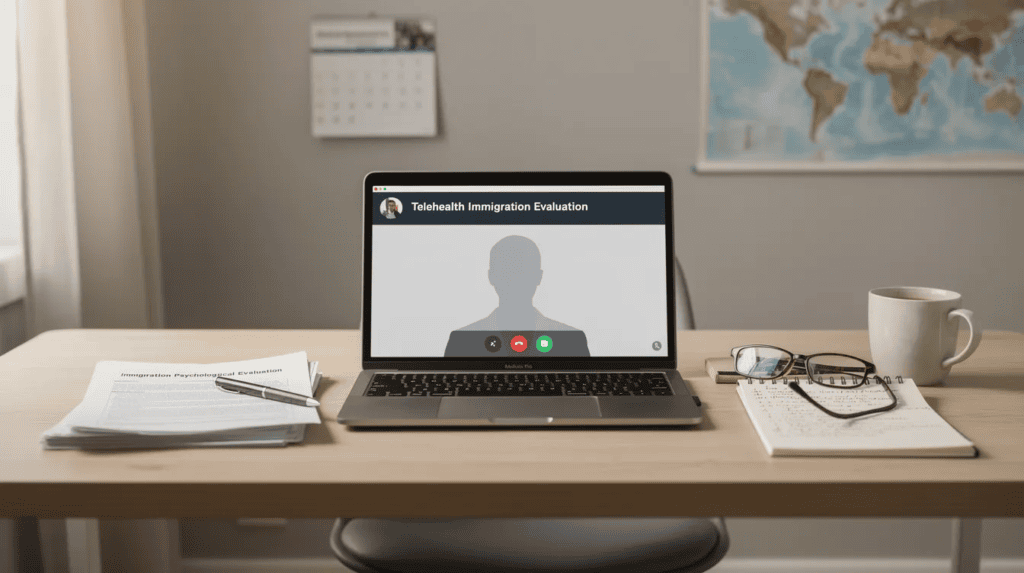
The first appointment fits into a four-stage process:
| Stage | What Happens | Typical Duration |
| Initial consultation | Clarify case type, deadlines, fees, language | 15-30 minutes |
| Evaluation session(s) | Clinical interview + screening tools | 1-3 hours across sessions |
| Report writing | Clinician drafts forensic report | 5 business days (standard) |
| Attorney review | Attorney checks report for legal alignment | Varies |
An immigration evaluation typically involves a psychological assessment that includes clinical interviews and standardized psychological testing. The evaluation duration typically spans one to three hours across multiple sessions, and most first appointments last about 90 to 120 minutes.
The goal of the evaluation is not to judge you. It exists to help tell your unique story in a way that supports your legal case. Clinicians at Immigration Evaluations of Texas bring extensive experience in forensic immigration evaluations, trauma-informed care, and cultural competence. Confidentiality is maintained throughout, and the evaluator explains its limits at the start of every session.
Immigration evaluations provide critical evidence for legal status applications, including U Visa, VAWA petitions, political asylum, T Visa applications, hardship waivers, Special Immigrant Juvenile Status, cancellation of removal, and removal of conditions cases.
2. Step-by-Step: What to Expect Before, During, and After the Appointment
This section walks through the full timeline, from scheduling your first call to receiving your completed report. Understanding each step removes much of the uncertainty that individuals and families feel when entering the immigration process.
The immigration evaluation institute, in this case Immigration Evaluations of Texas, manages intake, scheduling, and communication with attorneys. Evaluations are often initiated by immigration attorneys to support legal arguments in cases, but clients can also reach out directly to begin the process. Once contact is made, the practice confirms your case type (asylum, U Visa, VAWA, hardship waiver, etc.), your preferred language, your attorney’s information, and any upcoming court or filing deadlines.
Pre-appointment steps include:
- Completing intake forms and background questionnaires
- Signing informed consent and release-of-information forms so the evaluator can share the report with your attorney
- Gathering court or USCIS documents (I-918 for U Visa, I-589 for asylum, Form I-601 or I-601A for hardship waivers)
- Providing police reports, medical records, therapy records, or letters from family members
The first 10 to 15 minutes of your appointment cover essential groundwork:
- The clinician reviews consent and explains the limits of confidentiality. Confidentiality in immigration evaluations differs from regular therapy, as reports are shared with legal representatives.
- If the session is via telehealth, the clinician confirms your private space, stable connection, and comfort with the video platform.
- Language preferences are confirmed. Sessions are available in English and Spanish, and interpreters are arranged for other languages when needed.
The core clinical interview covers several areas:
- Personal history and family background
- Migration story and conditions in your home country
- Trauma history, if relevant to your case
- Current mental health symptoms such as anxiety, PTSD, depression, sleep disruption, or hypervigilance
- How symptoms affect daily life, work, school, and relationships
Questions differ depending on your case type:
- U Visa: Crime victimization and its psychological effects
- VAWA: Domestic abuse experiences and their impact
- Political asylum: Persecution, threats, fear of return tied to race, religion, nationality, political opinion, or social group
- T Visa: Trafficking experience and ongoing psychological harm
- Hardship waivers: Emotional, psychological, and financial consequences of separation from qualifying relatives
- SIJS, cancellation of removal, removal of conditions: Case-specific legal standards
Standardized screening tools such as the PHQ-9 (depression), GAD-7 (anxiety), and PCL-5 (PTSD checklist) may be used. The clinician explains each tool in plain language before you complete it.
Clinicians at Immigration Evaluations of Texas remain trauma-informed throughout: pacing the interview, offering breaks, and validating emotional reactions. There is no pressure to share everything at once. You will be heard, and the approach prioritizes your safety and comfort.
At the end of the appointment, the clinician summarizes what was discussed, answers your questions, clarifies next steps, and provides an estimated timeline for the written forensic report. Immigration Evaluations of Texas offers a standard 5-business-day turnaround, with 24-hour and 48-hour rush options when attorney deadlines are tight.
After the appointment, the clinician writes a 12 to 20 page, attorney-ready report linking mental health findings to the legal standards for the specific immigration relief being sought. With your permission, the evaluator may coordinate with your attorney to clarify legal questions, request additional documentation, or provide brief updates.
Example: Consider a fictional client named Maria, a 29-year-old woman applying for asylum. Her attorney refers her to Immigration Evaluations of Texas. During a telehealth session in Spanish, she reviews consent, discusses her family background and the assault she survived, and completes the PHQ-9, GAD-7, and PCL-5. A second session allows her to describe how nightmares and hypervigilance affect her work and parenting. Five business days after her final session, the evaluator delivers a 12-page report diagnosing PTSD and moderate depression, connecting both to the legal standard of persecution and fear of return.
2.1. Preparing for Your First Immigration Evaluation Appointment
Preparation makes the appointment more productive and less stressful. Your attorney, your evaluator, and you all benefit when the right materials are gathered beforehand.
Documents needed for an immigration psychological evaluation include government-issued IDs and legal paperwork. Here is a concrete checklist:
- Immigration notices and filings: I-918 (U Visa), I-589 (asylum), Form I-601 or I-601A (hardship waivers). Hardship waivers require detailed documentation of hardship, so gather any evidence of financial, medical, or emotional consequences.
- Police reports: Required for U Visa cases where crime victimization must be documented.
- Medical or ER records: Hospital visits, injury documentation, psychiatric records.
- Prior therapy records: Notes from therapists or counselors you have seen.
- Letters from family or community members: These can corroborate your experiences.
- Court documents: Protective orders, custody orders, or prior immigration filings.
Speak with your immigration attorney before the appointment to confirm the legal questions the evaluation should address, whether that is extreme hardship, risk of persecution, or the impact of abuse. This coordination ensures the clinician’s report answers what the court or USCIS adjudicator needs to see. To avoid common pitfalls, review this guide on top mistakes to avoid during an immigration psychological evaluation.
Reflect on key dates and events: when you entered the U.S., major incidents of harm, dates of diagnoses or hospitalizations. If you feel comfortable, write down a brief timeline. This is not required, but it helps you organize your thoughts and can reduce the stress of recalling details in the moment.
Telehealth preparation:
- Find a private space where you will not be interrupted
- Test your internet connection and video platform in advance
- Have headphones ready to protect your privacy
- Keep a photo ID nearby; the clinician will verify your identity at the start
You can request sessions in English or Spanish. When another language is needed, the practice arranges certified interpreters. Feeling anxious about the appointment is normal. There are no “right or wrong” answers. The clinician’s role is to understand your experience, not to test you.
2.2. During the Appointment: How Clinicians Address Mental Health and Trauma
This part of the immigration evaluation appointment is where the clinician focuses on your mental health, mapping the connection between what you have experienced and how it affects you now.
The clinician assesses a range of mental health symptoms:
- Mood and emotional state (sadness, fear, irritability, numbness)
- Sleep quality (insomnia, nightmares)
- Appetite changes
- Concentration and memory difficulties
- Panic attacks
- Flashbacks and intrusive memories
- Hypervigilance (feeling constantly on guard)
- Feelings of hopelessness or worthlessness
Evaluators may use validated psychological screening tools to assess mental health conditions, including the PCL-5 for PTSD, PHQ-9 for depression, and GAD-7 for anxiety. Each tool is explained in simple language before you complete it.

The evaluator then explores how trauma connects to your current functioning. For someone who survived domestic violence, the clinician documents how fear, avoidance, and hyperarousal interfere with daily tasks, employment, and caregiving. For a person fleeing political persecution, the focus shifts to documenting threats, harm, and the psychological weight of potential return.
How the evaluation differs by case type:
For political asylum cases, the clinician carefully documents past persecution, fear of return, and any threats or harm related to race, religion, nationality, political opinion, or social group. Psychological evaluations support asylum applications with critical evidence, and trauma-informed evaluations are essential for asylum seekers’ legal status.
VAWA stands for the Violence Against Women Act, and it provides legal protections for survivors of domestic violence. Psychological evaluations can support VAWA applications by documenting the emotional and psychological impact of abuse, including PTSD, depression, anxiety, and somatic symptoms such as chronic pain or gastrointestinal distress. VAWA applications require evidence of abuse or extreme hardship, and culturally competent evaluations are crucial for VAWA cases because they account for how cultural context shapes a survivor’s experience and willingness to disclose.
U Visa applications require evidence of victimization. Psychological evaluations can support U Visa applications by establishing the mental health consequences of the crime. Culturally competent evaluations are crucial for U Visa cases as well, particularly when clients come from communities where reporting violence carries stigma. U Visa evaluations can be conducted via telehealth, which removes geographic barriers for clients across Texas. For those looking for in-person options in North Texas, this guide covers where to get an immigration evaluation in Dallas.
Trauma-informed evaluations help clients discuss difficult experiences safely. Clinicians at Immigration Evaluations of Texas use culturally informed questions, avoid stigmatizing language, and respect spiritual and cultural understandings of mental health. If you become overwhelmed, the clinician offers breaks and may use grounding techniques, such as deep breathing or orienting to the room, to help you feel safer before continuing.
The professionalism and compassionate approach of the clinician shapes how comfortable you feel sharing your story. The evaluation is structured, but it is not rigid. The clinician follows your pace.
3. After the Appointment: Your Forensic Report, Timelines, and How It Supports Your Case
Once your first immigration evaluation appointment is complete, the clinician’s work shifts from interview to documentation. This is where your experiences, symptoms, and history become a structured legal document.
The clinician organizes interview notes, screening tool results, and psychosocial history into a forensic psychological report tailored to the specific immigration relief you are seeking. Psychological evaluations can result in a comprehensive report detailing the individual’s history and clinical findings, and this document becomes a core piece of evidence in your case.
A typical report includes:
| Report Section | What It Covers |
| Referral information | Why the evaluation was requested, evaluator credentials |
| Sources of information | Client interview, documents reviewed, collateral contacts |
| Psychosocial history | Family background, education, work, migration |
| Trauma history | Specific events, timeline, context |
| Mental status exam | Observations during the interview (mood, affect, cognition) |
| Diagnostic impressions | DSM-5 diagnoses (e.g., PTSD, major depressive disorder) |
| Functional impairment | How symptoms affect daily life, work, relationships |
| Legal standard section | How findings connect to the specific legal criteria |
Reports typically range from 12 to 20 pages in length. Immigration Evaluations of Texas delivers reports with a standard 5-business-day turnaround. When attorneys face court deadlines or Requests for Evidence (RFEs), 24-hour and 48-hour rush options are available.
Evaluations include clinical interviews and psychosocial history assessments, and the report reflects both. For asylum cases, evaluations include clinical interviews and trauma history assessments, and comprehensive reports for asylum cases typically range from 12 to 20 pages. Asylum evaluations can be conducted in multiple languages, which allows the clinician to capture nuance that might be lost through translation alone.

T Visa applications require trauma-informed psychological evaluations. Psychological evaluations support T Visa applications in legal proceedings by documenting the psychological consequences of trafficking, such as complex PTSD, dissociation, and attachment disruption. Comprehensive reports for T Visa cases typically range from 12 to 20 pages. Evaluations for T Visa cases are available in multiple languages. T Visa applicants often face financial barriers for evaluations; practices like Immigration Evaluations of Texas work to create accessible pathways for these clients.
Hardship waivers are for extreme hardship cases, and they can include psychological evaluations as supporting evidence. Evaluations for hardship waivers are often trauma-informed, documenting the emotional, psychological, and sometimes physical consequences of separating families or denying a waiver. These reports connect clinical findings to the “extreme hardship” standard that USCIS applies when adjudicating Form I-601 waivers.
U Visa applicants may also face financial barriers for evaluations. Immigration Evaluations of Texas provides clear fee information upfront so clients and attorneys can plan accordingly.
The review process works like this:
- The clinician finalizes the report and sends it to the attorney with the client’s consent.
- The attorney reviews the report for legal accuracy and alignment with the overall case strategy.
- If minor clarifications or additional documentation are needed, the evaluator addresses them promptly.
- In removal proceedings, the evaluator may be called to provide testimony.
Clients may be offered a follow-up session to clarify parts of their story, complete additional testing, or prepare for court testimony. The evaluation itself is not ongoing therapy, but clinicians can provide referrals for ongoing mental health support and services in the client’s local community. Individuals and families navigating the immigration process deserve access to both legal and therapeutic care.
Immigration Evaluations of Texas offers services statewide via telehealth, which means clients across Texas, from the Rio Grande Valley to the Panhandle, can access specialized immigration evaluations without long drives or missed work days. The practice’s training in forensic assessment, cultural understanding, and bilingual capacity creates a process where clients feel safe providing the information that strengthens their case.

The purpose of the first immigration evaluation appointment is to help tell your story accurately, with compassion, and in a way that supports your path to safety and stability in the United States. A well-documented psychological evaluation does not guarantee a case outcome, but it gives attorneys, judges, and adjudicators the clinical evidence needed to understand what you have lived through and what is at stake.
Schedule Your Immigration Evaluation Appointment
If you or someone you work with needs an immigration psychological evaluation, Immigration Evaluations of Texas is ready to help. We serve clients and attorneys statewide through telehealth, offering services in English and Spanish with interpreter support for other languages. Our standard turnaround is 5 business days, with 24-hour and 48-hour rush options for urgent deadlines.
Contact us today to schedule a consultation, discuss your case, and take the first step toward a report that tells your story with the clarity and impact it deserves.
Phone: Call or text to get started Online: Visit https://immigrationevaluationsoftexas.com to book your appointment
Share
Recent Posts

How Psychological Evaluations Help SIJS Cases
November 4, 2026
Imagine a teenager in Texas who fled abuse in their home country, now living with a foster family, attending a new school in...

What Is an Adam Walsh Waiver Evaluation?
November 2, 2026
When a U.S. citizen or lawful permanent resident with a past conviction involving a specified offense against a minor tries to sponsor a...

Can Children Receive Immigration Psychological Evaluations?
October 30, 2026
Yes-children can absolutely receive immigration psychological evaluations, and in many cases, these assessments are among the most influential pieces of evidence in a...