


August 7, 2026
Immigration Evaluations of Texas
Every year, thousands of people seek asylum in the United States after surviving war, torture, domestic violence, or political persecution in their home country. To succeed, each asylum seeker must prove a well-founded fear of persecution based on protected grounds under U.S. refugee law. But trauma rarely leaves a paper trail. That is where a psychological evaluation becomes one of the most important pieces of evidence in an asylum case.
A psychological evaluation documents the mental health impact of persecution – conditions like PTSD, depression, anxiety, and sleep disruption – in a structured, clinically grounded report that immigration judges and USCIS officers can weigh alongside testimony. In 2025, there were 9 million asylum seekers globally, and for many of them, expert psychological documentation made the difference between protection and deportation.

At Immigration Evaluations of Texas, we specialize in immigration-focused psychological evaluations for asylum, humanitarian visas, and other immigration relief. This article walks you through what these evaluations involve, how they strengthen asylum claims, and what to expect from the process – whether you are an applicant, or a family member.
What Is a Psychological Evaluation for Asylum Seekers?
In the immigration context, a psychological evaluation is a structured mental health assessment paired with a written forensic report designed to serve as legal evidence. It is not a pass-fail test. Instead, it answers specific clinical questions about a person’s trauma history, symptoms, diagnosis, and functional impairment.
This type of evaluation goes far beyond a standard therapy intake. Common purposes for psychological evaluations include accurate diagnosis, treatment planning, and understanding behavioral patterns – but in asylum cases, the report must also address legal standards such as credibility, consistency, and risk of harm upon return. Evaluations include tests, interviews, and assessments of behavior, all selected to help clarify complex mental health concerns for adjudicators who are not clinicians.
A licensed psychologist conducts all psychological evaluations. The evaluator should have experience in immigration and refugee law standards, cultural competence, and trauma-informed practice. While evaluations can be conducted in schools, hospitals, or outpatient facilities in other contexts, immigration psychological evaluations are typically done via secure telehealth or in a private clinical setting. At Immigration Evaluations of Texas, reports run 12–20 pages and are written in clear language that immigration judges and USCIS officers can act on.
How Psychological Evaluations Support an Asylum Claim
Under U.S. refugee law – grounded in the U.S. Refugee Act of 1980, which established asylum procedures – applicants must demonstrate persecution on protected grounds. Yet many human rights violations leave psychological scars rather than visible physical ones. Torture, sexual violence, forced recruitment, and domestic abuse often manifest as mental health disorders that only expert documentation can make visible to a court.
Here is how a well-executed evaluation helps:
- Clarifies severity. An accurate diagnosis helps identify or differentiate between mental health conditions such as anxiety disorders and depression, showing the court exactly how persecution has affected the person.
- Explains inconsistencies. Trauma causes memory fragmentation and dissociation. A forensic psychological report explains why testimony may vary over time – a result of cognitive impairment, not dishonesty.
- Documents risk of return. The evaluator provides an expert opinion on whether deportation would likely cause serious harm or worsen psychiatric symptoms.
Research from Physicians for Human Rights found that among asylum seekers who received medical or psychological evaluations between 2000 and 2004, 89% were granted asylum, compared to a national average of just 37.5%. A later study covering 2008–2018 showed a similar pattern: roughly 81.6% grant rate for evaluated cases versus approximately 42.4% nationally.
Evaluations can also assess learning or neurological differences such as ADHD or cognitive decline, and can offer reassurance by showing symptoms are not consistent with a particular disorder when that finding supports the case narrative. Immigration attorneys regularly submit these reports as supporting evidence in asylum claims, merits hearings, and appeals.
What Happens During a Psychological Evaluation? (Step-by-Step)
If you have never been through a psychological evaluation, the unknown can feel intimidating. Here is what the process actually looks like.
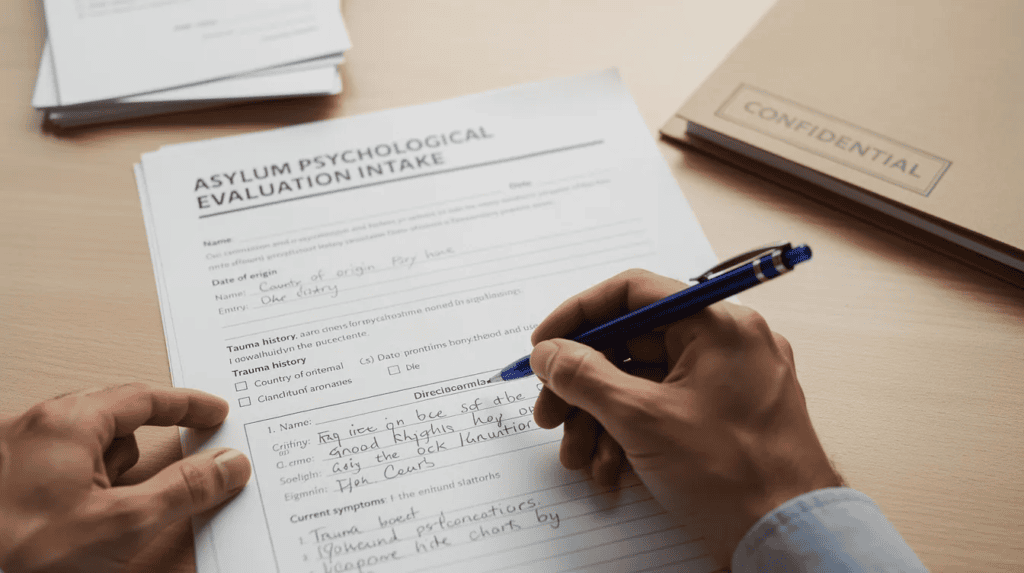
Stage 1 – Initial consultation. Schedule with Immigration Evaluations of Texas, confirm the immigration case type (asylum, withholding of removal, CAT), and review fees, timelines (standard 5-day report, with 24- or 48-hour rush options), and what to bring.
Stage 2 – Clinical interview. The clinical interview typically takes several hours to complete, sometimes split across sessions. It covers your psychosocial history, trauma events, current symptoms, and daily functioning. This can be done via secure video or in person, with bilingual support available. Behavioral observations report how you communicate and interact during the session – tone, affect, eye contact – all of which inform the clinician’s findings.
Stage 3 – Psychological testing. Standardized forms are used to assess mood, anxiety, attention, and personality. Common tools include the Harvard Trauma Questionnaire and the PCL-5, which have demonstrated approximately 86% sensitivity for detecting PTSD in refugee and asylum populations. Results establish a baseline for future comparisons and treatment monitoring.
Stage 4 – Document review. The psychologist reviews available medical history, prior mental health records, police reports, and country conditions evidence.
Stage 5 – Report writing. The forensic psychological report – typically 12–20 pages – includes a summary, diagnosis when appropriate, and expert opinion on trauma impact and risk upon return.
Stage 6 – Feedback. Feedback sessions involve discussing results and recommendations. Referrals for ongoing treatment or community support are provided as needed.
Key Components of an Asylum-Focused Psychological Report
Not all reports carry equal weight. Immigration-focused evaluations follow a specific structure aligned with standards like the Istanbul Protocol and recent consensus research on medico-legal affidavit quality.
A strong report includes:
- Identifying information and referral context – the asylum application overview.
- Psychosocial and medical history – displacement history, family history, family member losses, education, prior health care, and medical history.
- Narrative of persecution – a detailed, trauma-informed account of alleged human rights violations.
- Mental status examination – appearance, mood, cognition, and risk factors including suicidality.
- Psychological testing results – scored and interpreted by the clinician, with validity indicators.
- DSM-5-TR diagnoses – such as PTSD, major depressive disorder, or anxiety disorders, when clinically supported.
- Consistency analysis – connecting symptoms to persecution history and known patterns from refugee studies.
- Expert opinion – on credibility-consistent symptoms, functional impairment, and the likely impact of deportation.
The main goal of a psychological evaluation is to provide information that can guide care and support individualized to the person. Evaluations also identify specific strengths and weaknesses, and can document conditions for educational or workplace accommodations beyond the immigration context. Reports avoid advocacy language and rely on objective clinical findings to maintain credibility with judges and adjudicators.
Benefits for Asylum Seekers, Families, and Attorneys
The asylum process is stressful for applicants and their families alike. Asylum seekers have limited rights while awaiting a final decision on their legal status. A clear evaluation can bring both legal and personal benefits.
For asylum seekers:
- Validation that their symptoms are real, legally recognized, and clinically documented
- Increased understanding of their own mental health conditions and options for treatment
- A stronger, more credible narrative for their hearing or interview
For family members:
- Insight into why a loved one may be distant, irritable, or withdrawn
- Guidance on how to support healing while the case is pending
For attorneys:
- Structured, clinically grounded evidence to support legal arguments in asylum procedures
- Expert language explaining why inconsistencies stem from trauma, not dishonesty
- Option for expert testimony in immigration court
Psychological evaluations aid in formulating personalized treatment plans and guide targeted treatment strategies, meaning the benefits extend well beyond the courtroom. Asylum applications can be processed by government agencies or the UN Refugee Agency (UNHCR), and in all asylum systems, credible psychological documentation strengthens the applicant’s position.
It is also worth noting that evaluations support other immigration relief types. A hardship waiver is filed using Form I-601 or I-601A and allows individuals to overcome inadmissibility issues. The waiver process assesses the impact of separation on U.S. citizens, and hardship waivers are crucial for family unity in immigration cases. Approval rates for hardship waivers vary by case specifics, but strong psychological evidence consistently helps.
Telehealth, Accessibility, and Trauma-Informed Care
Telehealth has expanded access to psychological evaluations for asylum seekers across Texas and in other countries where applicants may be located. Immigration Evaluations of Texas uses secure, HIPAA-compliant platforms for video sessions, protecting confidentiality for every person involved.

Language access matters:
- Bilingual English and Spanish services are available
- Vetted interpreters assist refugees and applicants who speak other languages
- Interpreters are briefed on trauma-sensitive communication
Trauma-informed principles guide every session:
- Asking permission before discussing painful events
- Pacing sessions, offering breaks, and normalizing common trauma reactions
- Accommodations for survivors of torture, sexual violence, or LGBTQ+ persecution, including choice of evaluator gender when possible
Research has shown that telephonic and video evaluations yield affidavits of comparable quality to in-person sessions when assessed against Istanbul Protocol benchmarks. Evaluations are not therapy, but they often become the first step toward ongoing mental health care, and referrals to organizations and communities offering resettlement support can be provided.
Conclusion & Call to Action
A psychological evaluation translates lived trauma into structured, credible evidence that fits within refugee law and human rights frameworks. It documents the mental health impact of persecution, supports credibility in front of USCIS or an immigration judge, and provides a compassionate, trauma-informed space for a person to tell their story. Whether the case involves physical health consequences, illnesses, or disorders that are purely psychological, expert documentation makes the invisible visible.
If you are an asylum seeker, a family member supporting someone through the asylum process, we encourage you to schedule an evaluation with Immigration Evaluations of Texas. Evaluations are available via telehealth throughout Texas, with standard and rush turnaround options.
Every person who has fled persecution deserves safety, dignity, and the right to seek asylum with proper mental health support behind them.
Share
Recent Posts

Immigration Psychological Evaluation vs Therapy: What Is the Difference?
September 18, 2026
An immigration psychological evaluation is a formal, time-limited mental health assessment conducted specifically to support an immigration case. It is not ongoing treatment....

What Is Included in an Immigration Psychological Evaluation Report?
September 16, 2026
An immigration psychological evaluation report is one of the most important pieces of evidence you can submit in a U.S. immigration case. Whether...

How Psychological Evaluations Help U Visa Applicants
September 14, 2026
The U visa was created in 2000 under the Victims of Trafficking and Violence Protection Act. It provides a nonimmigrant status visa for...