


October 23, 2026
Immigration Evaluations of Texas
Yes. Emotional abuse can qualify as battery or extreme cruelty for an I-751 waiver, even if you never called the police and have no physical injuries to show. Under the Immigration and Nationality Act and USCIS regulations, extreme cruelty encompasses far more than bruises or broken bones. It includes threats, isolation, control over money and documents, constant humiliation, and any pattern of behavior designed to dominate you.
USCIS looks at patterns, not just single events. If your abusive spouse repeatedly threatened to have you deported, withheld money, hid your passport, or cut you off from family members, those acts can form the basis of an abuse waiver. The key is showing that the behavior was intentional, repeated, and caused you physical or mental injury.
As a conditional resident, you have the right to request a waiver of the joint filing requirement if your U.S. citizen or LPR spouse subjected you to domestic violence during the marriage. You do not need your spouse’s cooperation or signature. Self-petitioners can file Form I-751 individually due to abuse.
If you’re separated or divorced, you can still remove conditions on your green card. You’ll need to demonstrate that you entered a good faith marriage and that you experienced abuse. The path forward exists, even when it feels like every door has been closed.
Understanding I-751 Petitions and the Joint Filing Requirement
Form I-751 is the immigrant petition that conditional permanent residents use to remove conditions on their green card and become full lawful permanent residents. If you obtained your green card through marriage and that marriage was less than two years old when your status was approved, your card carries a two-year expiration. The I-751 is how you convert conditional residency into permanent residence with a 10-year card.
Under normal circumstances, the joint filing requirement means both spouses file Form I-751 together within the 90-day window before the conditional card expires. Your permanent resident spouse or U.S. citizen spouse signs the form alongside you, and you submit copies of evidence showing your marriage is still intact and genuine.
But life doesn’t always follow a standard path. When a marriage falls apart or becomes dangerous, the law provides three main waiver categories:
- A good faith marriage that ended in divorce (supported by a divorce decree)
- Battery or extreme cruelty by the U.S. citizen or LPR spouse
- Extreme hardship if the conditional resident were removed from the United States
These waivers allow you to file alone, without your spouse’s knowledge or participation. That’s especially important when your spouse was the source of the harm.
What Counts as Battery or Extreme Cruelty Under I-751?
The terms “battery” and “extreme cruelty” come from USCIS regulations at 8 CFR 216.5(e)(3)(i), which borrow heavily from the broader framework established by the Violence Against Women Act. Battery includes any act of violence causing injury, including offensive touching without consent. Acts of violence can include rape and forced prostitution. But the definition does not stop at physical abuse.
Extreme cruelty includes psychological or sexual abuse, threatened acts of violence, forced confinement, withholding money, controlling access to healthcare, and any sustained campaign of intimidation. USCIS evaluates claims of extreme cruelty on a case-by-case basis, looking at the totality of the circumstances rather than applying a rigid checklist.
Here are concrete behaviors that can qualify: repeated insults designed to erode your self-worth, gaslighting that makes you question your own reality, threats to call ICE or withdraw immigration sponsorship, hiding passports or identity documents, forced isolation from friends and community, controlling access to children or medical care, destroying personal property, and monitoring your phone or text messages.
Both women and men can qualify for this waiver, regardless of gender or sexual orientation. What matters is the pattern: did one spouse systematically dominate, threaten, or control the other? If so, that behavior meets the threshold for extreme cruelty, even without a single police report. Abuse includes physical violence and psychological control in equal measure under this standard.
Recognizing Emotional Abuse in a Marriage to a U.S. Citizen or Permanent Resident Spouse
Many survivors minimize emotional abuse because there are no bruises to photograph and no hospital visits to document. You might tell yourself it wasn’t “that bad” or that other people have it worse. But if your spouse’s behavior left you afraid, isolated, or unable to make basic decisions about your own life, that is abuse.
Common emotional abuse tactics in I-751 cases include constant criticism of your intelligence, appearance, or culture. Humiliation in front of others or in private. Intentional isolation from your family in your home country. Controlling all bank statements and finances so you had no independent access to money. Monitoring your phone, email, and social media. Threatening to withdraw immigration sponsorship or “send you back.” Restricting access to children born during the marriage or threatening to take them away.
Think about whether things got worse after you received your conditional green card. Did your spouse’s behavior escalate once they believed you were dependent on them for your immigration status? Write down examples with approximate dates.
Consider a scenario: Maria married a U.S. citizen in 2020 and received conditional residency in 2021. From 2021 to 2023, her spouse controlled all household finances, refused to let her work, monitored her phone, and repeatedly told her she would be deported if she complained. There was no physical violence, but Maria developed anxiety and insomnia. After separating in 2023, she worked with a therapist and domestic violence advocate to name and document the emotional abuse she had endured.
Talking with a therapist or domestic violence advocate can help you recognize and document emotional abuse, even if there was never a 911 call. Social workers at shelters and advocacy organizations hear stories like yours every day.
Eligibility for an I-751 Waiver Based on Battery or Extreme Cruelty
To file an I-751 waiver based on abuse, you must be a conditional resident who was married to a U.S. citizen or permanent resident spouse who was abusive during the marriage. Self-petitioners must demonstrate a qualifying relationship to the abuser and must have resided with the abuser during the relationship.
The marriage must have been entered in good faith-meaning you intended to build a life together, not solely for an immigration benefit. Even if the relationship later became abusive, what matters is your intent at the time of the wedding. USCIS allows self-petitioners to file without their spouse’s involvement, and importantly, USCIS does not notify abusive spouses about the details of abuse-based waiver applications. Your safety is protected under confidentiality provisions in 8 U.S.C. § 1367.
You can file the waiver whether you are still married, separated, or divorced, as long as the I-751 is submitted before you are removed from the United States. When both abuse and divorce apply, you can check more than one waiver box on the form.
Conditional resident children who were abused by a U.S. citizen or permanent resident parent can also qualify for a similar waiver. And the abuse does not have to occur in the U.S.-abuse that happened abroad while the bona fide marriage existed can still be considered.
Good Faith Marriage vs. Marriage Fraud: Why It Matters
USCIS always examines whether the marriage was entered in good faith, even in abuse cases. This isn’t optional. An effective documentation strategy for an I-751 abuse waiver requires proving both good faith marriage and extreme cruelty.
A good faith marriage-sometimes called a bona fide marriage-simply means you and your spouse genuinely intended to share a life together at the time of the wedding. It doesn’t matter that the relationship later fell apart. It doesn’t matter that you’re now separated or divorced. What matters is your intent when you said “I do.”
Common evidence of a bona fide relationship includes:
- Joint lease or mortgage documents
- Shared bank accounts or joint accounts
- Insurance policies listing both names
- Tax returns filed jointly
- A marriage certificate
- Photos with family and friends at events and holidays
- Birth certificates of children born during the marriage
- Communication records showing genuine connection
- Travel records from trips taken together
Here’s the challenge: abuse often destroys typical marriage evidence. An abusive spouse may keep finances separate, hide mail, forbid social media photos, or refuse to add your name to the lease. If that happened to you, explain it in your personal statement. Affidavits from friends or family members and psychological evaluations can help fill these gaps.
Even if the marriage ended quickly because of abuse, that alone does not mean marriage fraud occurred. Short marriages can be genuine marriages that became dangerous.
Types of I-751 Waivers: Abuse, Divorce, and Extreme Hardship
There are three main waiver categories for filing I-751 without your spouse:
| Waiver Type | Core Requirement | Key Evidence |
| Good faith marriage ended in divorce | Marriage was genuine; legally terminated | Divorce decree, marriage evidence |
| Battery or extreme cruelty | Abuse during the marriage | Personal statement, evaluations, other evidence |
| Extreme hardship if removed | Removal would cause suffering beyond normal | Medical reports, country conditions, mental health records |
A petitioner can check more than one waiver box when the facts support it. For example, if you divorced because of abuse, you can file under both the divorce and the abuse waiver bases simultaneously.
USCIS also allows waivers for extreme hardship without abuse history. Extreme hardship means suffering that goes beyond the normal disruption of leaving the country-serious medical conditions, lack of access to care, or danger in the home country. If you would suffer extreme hardship upon removal, this is a separate but sometimes overlapping ground.
The abuse waiver and hardship waivers are distinct from, but conceptually related to, protections under the Violence Against Women Act. An immigration law attorney can help you identify the strongest waiver combination based on your history.
Documenting Emotional Abuse: What USCIS Looks For
USCIS applies an “any credible evidence” standard when reviewing abuse claims. That means there is no single required document. Credible evidence can include any documentation relevant to emotional abuse claims-from therapy notes to text messages to a handwritten letter from your neighbor.
However, “any credible evidence” does not mean “anything goes.” USCIS evaluates evidence based on credibility and detail. Emotional abuse evidence often looks different from physical abuse evidence. There may be no hospital records, no photographs of injuries, no police reports. Instead, the case relies heavily on the applicant’s narrative, witness letters, and expert evaluations.
Strong evidence shares these core qualities:
- Specific dates (month and year at minimum)
- Clear examples of abusive behavior with concrete details
- A direct connection between the abuse and the mental or physical impact on you
- Consistency across all documents-your personal statement, witness letters, and professional reports should tell the same story without contradictions
Focus on building a timeline that covers the entire marriage: courtship, early relationship, escalation of abuse, and separation. Approximate dates matter because they give USCIS officers a way to track the pattern.
Contradictions or vague statements can trigger a Request for Evidence or difficult interview questions. Clarity and honesty are more persuasive than dramatic language. Specific incidents of emotional abuse should be documented with dates and details whenever possible.
Key Evidence to Support Emotional Abuse in I-751 Petitions
Gathering evidence for I-751 petitions does not require police reports. Many survivors never call the police, and that is understandable. Police reports and medical records are powerful when available, but they are not mandatory. Evidence of abuse can include police reports and medical records, but USCIS recognizes that many abuse victims lack these documents.
USCIS allows for the submission of digital communications as evidence of abuse. Screenshots of threatening text messages, WhatsApp conversations, voicemails, emails, and social media messages can all demonstrate a pattern of control and cruelty. For example, screenshots of messages from May 2022 where your spouse threatens to cancel your green card if you disagree with them are exactly the kind of concrete proof that resonates with USCIS officers.
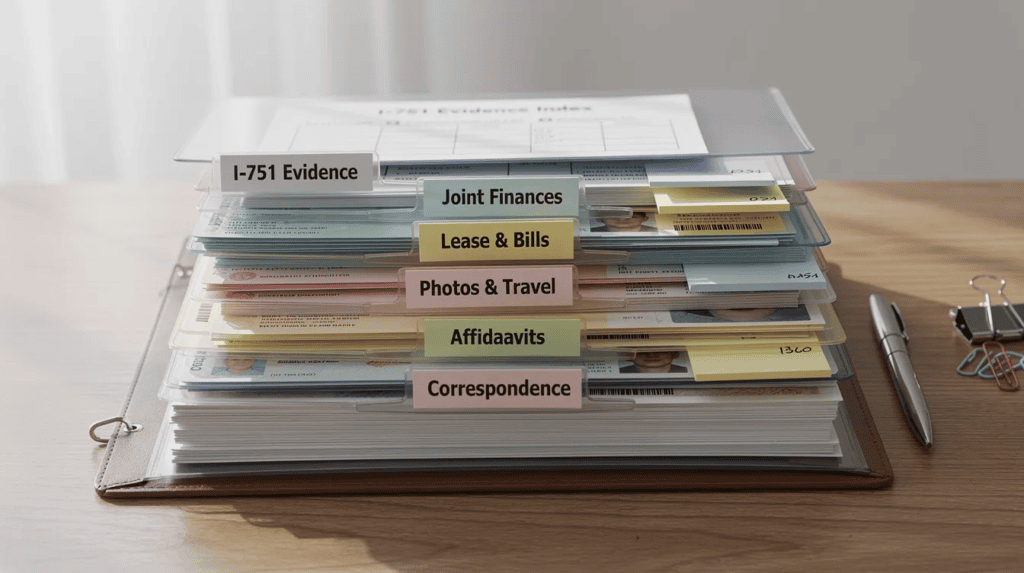
Here are the most common categories of supporting evidence for emotional abuse in I-751 petitions:
- Personal affidavit: Your sworn, detailed account of the abuse in your own words
- Psychological evaluation: A forensic report from a licensed mental health professional linking abuse to symptoms like PTSD, depression, or anxiety
- Therapy and medical records: Records from counselors, therapists, or doctors documenting symptoms or disclosures
- Digital communications: Text messages, emails, voicemails, or social media posts showing threats, insults, or controlling behavior
- Third-party affidavits: Sworn letters from friends, family members, coworkers, pastors, or domestic violence advocates
- Legal documents: Restraining orders, protection orders, court filings, or a divorce decree
- Shelter and social services records: Documentation from domestic violence shelters, hotlines, or support agencies
- Photos: Images of property damage, destroyed personal property, or any visible effects of abuse
All copies should be clear and legible. Submit copies of documents in languages other than English with certified translations. Organize materials with labels or tabs so the immigration officer can follow your story without confusion.
Personal Statement: Telling Your Story of Emotional Abuse
Your personal statement-your sworn affidavit-is the heart of an emotional abuse–based I-751 waiver. Personal declarations are central pieces of evidence in I-751 abuse waiver cases. Personal statements detailing abuse are crucial evidence because they give USCIS the narrative framework that holds all other documents together.
A strong personal statement follows a clear structure:
- How you met and married: Where, when, what drew you together
- Good times and early warning signs: Evidence of a genuine relationship and the first moments of concern
- Specific abusive incidents: Describe each with the date (or approximate month/year), location (such as “our apartment in Houston in 2021”), what was said or done, and how it affected you
- Impact on your mental and physical health: Anxiety, depression, sleep problems, fear, isolation
- Why you stayed: Immigration dependence, cultural pressure, children, fear of retaliation
- How the relationship ended or changed: Separation, divorce, or ongoing danger
Include direct quotes from the abuser when you remember them. Describe how the abuse escalated over time. If your spouse told you in December 2022 that you were “nothing without a green card” and would be “sent back,” write exactly that.
Address any gaps. If you did not call the police in 2020, explain why-maybe you feared deportation, didn’t speak English well, or your spouse controlled your phone. These explanations help USCIS understand context rather than assuming you have something to hide.
Some survivors write the first draft alone and then review it with an attorney or psychologist to ensure clarity and emotional safety. You don’t have to get it perfect on the first try. You can learn more about avoiding common pitfalls in our guide on top mistakes to avoid during an immigration psychological evaluation.
Psychological Evaluations and Expert Reports in Abuse-Based I-751 Cases
A forensic immigration psychological evaluation is not the same as a regular therapy session. It is a structured, detailed assessment prepared specifically for legal proceedings. The evaluator examines your history, current symptoms, and the connection between what happened in the marriage and how you are functioning today.
Professional evaluations carry significant weight when documenting psychological cruelty in I-751 petitions. Expert testimony from licensed professionals is essential for mental cruelty claims because it translates your lived experience into clinical language that USCIS officers understand. A licensed psychologist can document symptoms consistent with emotional abuse: PTSD, major depression, generalized anxiety, panic attacks, sleep disturbances, or difficulty concentrating.
Strong reports include several components:
- A clinical interview covering the full relationship and abuse history
- Use of standardized screening tools (such as the PCL-5 for PTSD or the PHQ-9 for depression) when clinically appropriate
- Clear diagnostic impressions connecting the abuse to current symptoms
- The clinician’s professional credentials and licensing information
- Language accessible to non-clinicians

Immigration Evaluations of Texas provides detailed psychological evaluations for I-751, VAWA, and hardship waivers with a standard 5-day turnaround and 24- or 48-hour rush options. Evaluations are available via telehealth across Texas and, where permitted, other states, with bilingual English/Spanish services. If you’re looking for an evaluator, our guide on the benefits of early psychological evaluations in immigration cases explains why getting this step right matters.
A well-prepared evaluation can significantly strengthen evidence of extreme cruelty, especially when there is little or no police involvement.
Third-Party Evidence: Witness Letters and Community Documentation
Third-party statements are letters from people who observed the abuse or its effects on you: friends, family members, neighbors, coworkers, pastors, school officials, or domestic violence advocates. Affidavits from third parties can provide corroboration for emotional abuse claims that might otherwise rest solely on your word.
Each affidavit should include:
- The writer’s full name, date of birth, and contact information
- How they know you and for how long
- Specific things they saw, heard, or were told, with approximate dates
- A statement made under penalty of perjury that the contents are true
- The writer’s personal knowledge of the situation
Here are concrete examples of useful third-party documentation: an email from a supervisor noting that you were frequently distressed at work during 2022, a church leader’s letter describing disclosures of abuse you made in 2023, or a teacher’s report noting behavioral changes in your children that coincided with the period of abuse.
Letters should avoid copying each other’s language. Each should be written in the writer’s own words and, if in a language other than English, accompanied by a certified English translation. If multiple witnesses use identical phrasing, USCIS may question their credibility.
Documentation from shelters can support abuse claims. Documentation from social services and shelters can further support I-751 abuse claims. If you sought help from a domestic violence hotline, shelter, or support group-even just once-request records or a letter confirming your contact with them.
Organizing Evidence for Emotional Abuse and Extreme Cruelty Claims
A well-organized I-751 packet makes it easier for a USCIS officer to see the full picture. Documents should be organized to effectively present the narrative of abuse, guiding the adjudicator through your story logically rather than forcing them to piece together scattered papers.
Start with a clear cover letter that lists each waiver box you checked (battery or extreme cruelty, divorce, extreme hardship) and briefly summarizes the evidence attached.
Group your evidence into labeled sections:
| Section | Contents |
| 1. Forms and fees | I-751, fee waiver request if applicable |
| 2. Identity documents | Green card copy, passport, birth certificates |
| 3. Good faith marriage evidence | Photos, joint accounts, tax returns, marriage certificate |
| 4. Abuse and extreme cruelty | Personal statement, communications, police reports if any |
| 5. Psychological impact | Evaluation report, therapy records, medical reports |
| 6. Third-party support | Witness affidavits, shelter records, school records |
Number exhibits (Exhibit A, B, C) and include a simple index or table of contents at the front of the packet. This small effort signals professionalism and makes the officer’s job easier.
Keep complete copies of everything you submit, including your affidavit and all supporting materials, stored in a safe, private location away from the abusive spouse.
Filing Timing and Deadlines When Leaving an Abusive Marriage
The standard filing window opens 90 days before your conditional green card expires. But filing an I-751 waiver can occur after the 90-day window. Abuse-based waivers can be filed early or even after the card expires if there is a legitimate reason for the delay.
USCIS can accept late filings when the conditional resident demonstrates “good cause and extenuating circumstances.” Severe trauma, hospitalization, the abusive spouse hiding mail or immigration documents, or being physically prevented from filing are all recognized reasons.
Once your I-751 is filed, USCIS issues a receipt notice that automatically extends your LPR status, allowing you to continue working and traveling while the case is pending. This extension protects you from falling out of status during what can be a lengthy process.
Here’s a typical timeline: marriage in 2020, conditional green card issued in 2021, emotional abuse escalating from 2021 to 2023, separation in late 2023, I-751 abuse waiver filed in early 2024. The case might take over a year to adjudicate, with a potential interview scheduled during that time.
If your card is already expired or you missed the 90-day window, do not wait. Contact an immigration attorney immediately. Delay only makes things harder.
How Emotional Abuse Evidence Interacts With Extreme Hardship Waivers
Sometimes the same facts that support an abuse waiver also support an extreme hardship waiver. If you developed PTSD or major depression as a direct result of chronic emotional abuse, those conditions can become part of a hardship argument-especially if returning to your home country would worsen your symptoms or cut off access to treatment.
Concrete examples of hardship connected to abuse include: lack of mental health services in the home country, ongoing danger from the abuser’s family abroad, cultural stigma around divorce and mental illness that would isolate you further, or the need for ongoing therapy that is only available in the U.S.
The distinction matters. Hardship waivers focus on what would happen if you had to leave the U.S., while abuse waivers focus on what happened during the marriage and how it affected you as an abuse victim. When both apply, filing under both bases strengthens your case. USCIS adjudicators consider whether you would suffer extreme hardship upon removal as a separate but complementary question.
A psychological evaluation can address both extreme cruelty and anticipated hardship if removal occurs. When your evaluator understands both standards, they can write a report that serves double duty.
How I-751 Abuse Waivers Differ From VAWA Self-Petitions
The I-751 abuse waiver and the VAWA self petition serve different purposes at different stages of the immigration journey. An I-751 removes conditions from an existing marriage-based green card. A VAWA self petition (Form I-360) is used to obtain lawful immigration status when the abusive marriage occurred before or during the green card process.
Both use the battery or extreme cruelty standard, and both allow filing without the abusive spouse’s knowledge. But VAWA cases are handled by a special confidential unit within USCIS, while I-751 petitions are processed through USCIS Service Centers.
Some survivors progress from VAWA to permanent residency and later file I-751 if they initially obtained only conditional status. Understanding which form applies to your situation requires looking at where you are in the immigration process.
The protections under the Violence Against Women Act-despite its name-apply to all genders. The nationality act provisions are gender-neutral.
Immigration Evaluations of Texas frequently prepares psychological evaluations tailored to both VAWA self-petitions and I-751 abuse waivers, aligning each report to the specific legal standard at issue. If you’re unsure which path fits your case, an immigration evaluation in Dallas or anywhere in Texas can help clarify next steps.
What to Expect After Filing an I-751 Based on Emotional Abuse
After filing, the process unfolds in stages. First, you’ll receive a receipt notice confirming your I-751 was accepted. This notice extends your conditional residency and work authorization. Next, USCIS will schedule a biometrics appointment for fingerprinting and a background check.
In many abuse waiver based cases, USCIS may schedule an in-person interview. Expect sensitive questions about your marriage, the timeline of abuse, and specific incidents. The officer may ask you to describe particular events in detail to test consistency with your written statement. Bringing originals of key documents and attending with an immigration attorney can make a significant difference.
USCIS may also issue a Request for Evidence asking for additional documentation. Respond by the deadline, and consider supplementing with updated psychological or medical evidence if your condition has changed since filing.
Processing times vary. As of FY 2026 Q3, the median processing time for all I-751 petitions is approximately 22.6 months. Abuse waiver cases often take longer due to the complexity of the evidence review. Stay attentive to mail and online notices. If you receive a Notice of Intent to Deny, treat it as an urgent deadline-not a final answer.
How Immigration Evaluations of Texas Can Help Document Emotional Abuse
Immigration Evaluations of Texas specializes in forensic psychological evaluations for immigration matters, including I-751 abuse waivers, VAWA, U-Visas, T-Visas, hardship waivers, asylum, special immigrant juvenile status, and cancellation of removal cases.
The evaluation process follows a clear path:
- Initial consultation: Discuss your case and determine whether a psychological evaluation would strengthen your petition
- In-depth clinical interview: A thorough conversation about your relationship history, specific abusive experiences, and current symptoms
- Clinical measures: Standardized screening tools used when clinically appropriate to document PTSD, depression, anxiety, or other conditions
- Detailed report: A 12–20 page attorney-ready document linking the abuse to psychological symptoms and, where applicable, anticipated hardship
Reports include the clinician’s credentials, diagnostic impressions when warranted, and explanations written in language that USCIS officers can understand. Evaluations are available via telehealth for clients across Texas and other permitted states, with bilingual English/Spanish services. Standard turnaround is 5 days, with 24- or 48-hour rush options available.
To learn more about choosing the right evaluator, visit our guide on how to choose the right immigration evaluation provider in Texas.
Practical Tips for Staying Emotionally Safe While Preparing Your Case

Revisiting past abuse in affidavits, evaluations, or interviews can be emotionally triggering. That reaction is normal, and it does not mean you aren’t strong enough to do this.
Here are practical steps to protect yourself during the process:
- Work on documents in small increments rather than marathon sessions
- Take breaks when you feel overwhelmed-step outside, call a friend, breathe
- Have a trusted person (therapist, friend, or advocate) available for support during difficult writing sessions
- Store all paperwork in a safe, private location your abusive spouse cannot access
- If the abuser still has contact with you, use safe devices or email accounts for case-related communications
- Consider contacting a domestic violence shelter or hotline for safety planning resources
- Talk with your attorney about address confidentiality options
Mental health services, including telehealth therapy, can help manage anxiety and trauma symptoms throughout the legal process. Seeking support does not weaken your case. It strengthens it-and it protects you.
Conclusion: You Can Protect Your Status Without Staying in an Abusive Marriage
Emotional abuse qualifies as extreme cruelty under immigration law. Evidence can be built even without police reports, medical records, or visible injuries. And survivors have clear legal options to remove conditions on their green card without the cooperation of an abusive spouse.
U.S. immigration law does not require anyone to remain in a harmful relationship to keep a green card. The waiver exists specifically because Congress and USCIS recognized that forcing an abuse victim to depend on their abuser for immigration status is unjust.
Start gathering evidence step by step. Reach out to an experienced immigration attorney. Consider a psychological evaluation to document the impact of abuse and any extreme hardship factors. You can schedule a consultation with Immigration Evaluations of Texas by phone or through our online booking page to discuss whether an evaluation could strengthen your case.
Taking action now-even one small step like writing down what happened-can open a path toward long-term safety and stability. You deserve that path.
Share
Recent Posts

How Psychological Evaluations Help SIJS Cases
November 4, 2026
Imagine a teenager in Texas who fled abuse in their home country, now living with a foster family, attending a new school in...

What Is an Adam Walsh Waiver Evaluation?
November 2, 2026
When a U.S. citizen or lawful permanent resident with a past conviction involving a specified offense against a minor tries to sponsor a...

Can Children Receive Immigration Psychological Evaluations?
October 30, 2026
Yes-children can absolutely receive immigration psychological evaluations, and in many cases, these assessments are among the most influential pieces of evidence in a...